
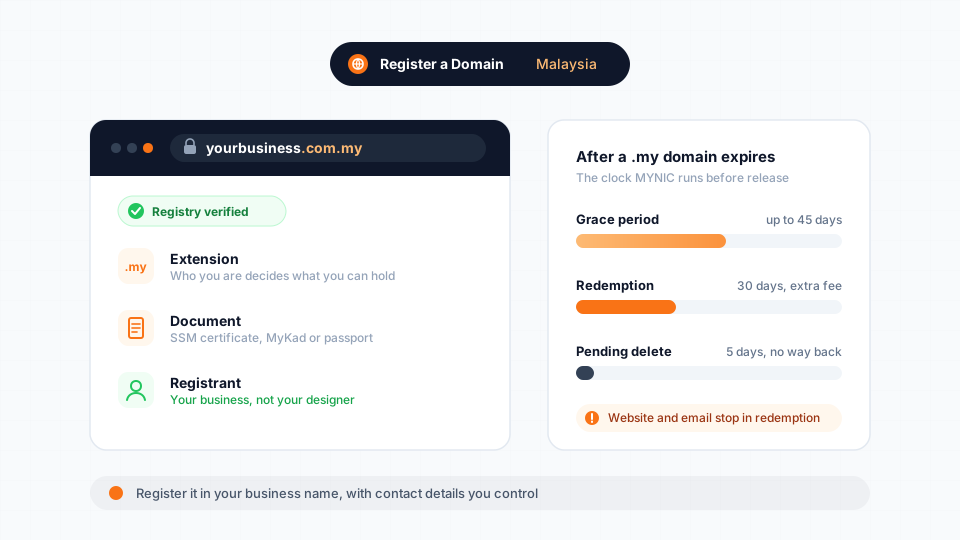
Registering a .com takes about ten minutes. Registering a .com.my takes two or three working days. The checkout is the same; the difference is that Malaysian domains go through MYNIC, the national registry, which checks whether you are allowed to hold the name before it goes live.
Most of what goes wrong with a domain happens before anyone pays. The wrong extension for the kind of entity you are. A domain registered in the web designer's name instead of the company's. None of it is complicated, but a lot of the advice still circulating describes eligibility rules that MYNIC has since changed.
This guide follows the order you will actually make the decisions in: which extensions you are eligible for, what documents to prepare, whose name goes on the registration, and what to do once it is live. The eligibility rules come from MYNIC's current Registrant Policy, effective 26 May 2025.
The Short Version
If you only read one section, read this one:
- Decide who the owner is. A company, a sole proprietorship, a society, or you personally. That one fact decides which extensions you can register.
- Pick the extension.
.com.myif you are registered in Malaysia and sell mainly here..myif you are an individual, based overseas, or want the shortest name..comif your customers are international. - Have the document ready. An SSM certificate, a society registration, or a MyKad or passport.
- Register in the exact legal name of the person or business that should own it, not whoever happens to be setting it up.
- Switch on auto-renew and the registrar lock, then point the domain at your hosting.
Step 1: Work Out Which Extensions You Can Register
Malaysian domains, everything ending in .my, are run by MYNIC under the oversight of the Malaysian Communications and Multimedia Commission. Generic extensions such as .com, .net and .shop are run by other registries under ICANN rules and are open to anyone, with no documents.
Here is who MYNIC allows to register each Malaysian extension:
| Extension | Who can register it | What you will usually need |
|---|---|---|
.my | Anyone: individuals or organisations from any country | MyKad or passport for a person; registration certificate for an organisation |
.com.my | Organisations registered in Malaysia: companies, SSM-registered businesses (including sole proprietors and partnerships), societies, professional firms, foreign companies registered with SSM | SSM certificate, or the equivalent for your type of organisation |
.net.my | The same organisations as .com.my, intended for network-related activity | As for .com.my |
.org.my | The same eligibility list, intended for non-profit and charitable organisations | Usually a society registration (ROS) certificate |
.biz.my | Businesses and SMEs, including businesses holding a local council licence or permit under the Local Government Act 1976 | Business registration or council licence |
.name.my | Individuals aged 18 or over who hold a MyKad, or foreigners aged 18 or over living in Malaysia | MyKad, or passport plus proof of Malaysian residence |
.edu.my, .gov.my, .mil.my, .coop.my | Reserved for educational institutions, government bodies, the Ministry of Defence, and co-operatives registered with SKM | Proof of that status |
.com, .net, .org and other generic extensions | Anyone | Nothing beyond accurate contact details |
.com.my too: MYNIC accepts a business registered under the Commercial License Ordinance 1948 in place of SSM registration.
The two rules people get wrong
An individual cannot hold a .com.my. Every one of MYNIC's eligibility categories for .com.my is an organisation: a company, a registered business, a society, a firm, an agency. A private person is not on the list. If you are a freelancer who wants a .com.my, the route is to register a sole proprietorship with SSM first, which does qualify, and then register the domain in the business's name. Otherwise, .my is open to you today.
.my is not limited to Malaysians. Older guides describe .my as a domain for Malaysian residents. The current policy says the opposite: registration is open to individuals and entities from any country, with no geographic restriction. A Singapore company selling into Malaysia, or a Malaysian living abroad, can register a .my directly.
If you qualify for more than one extension and cannot decide, our comparison of .com.my and .com walks through the trade-offs, including when it is worth holding both.
Step 2: Prepare the Right Documents
MYNIC checks every application against these eligibility rules before the domain goes live, and may ask for supporting documents to confirm who you are. Having the right one ready is the difference between activation in two days and a week of email back and forth.
- Sdn Bhd or Bhd company: your SSM incorporation document. For companies incorporated under the Companies Act 2016, that is the Section 17 notice; older companies have a Form 9 certificate.
- Sole proprietorship or partnership: your SSM business registration certificate (Borang D, or the e-SSM printout).
- Business in Sabah or Sarawak: your trading licence under the Commercial License Ordinance.
- Society, association or club: your Registrar of Societies certificate.
- Malaysian individual (for
.myor.name.my): a copy of your MyKad. MYNIC asks that the copy be crossed with diagonal lines and marked "For .my domain Use Only", which is good practice for any ID copy you send anywhere. - Non-Malaysian living in Malaysia: an Employment Pass, Student Pass or a passport with a Permanent Resident endorsement.
- Individual or company outside Malaysia (for
.my): a passport, national ID or driving licence for a person, or a company certificate from your home country for an organisation.
Budget the time as well. Malaysian domains typically activate within two to three working days while generic domains activate in minutes. If you are launching on a fixed date, and especially if your SSM registration is still in progress, register the domain as early as you can. The .com.my domain page covers the extensions we register and what we need from you.
Step 3: Register It in the Right Name
This is the step that costs businesses the most, years after the fact.
MYNIC's policy is explicit that a domain name is held on a subscription basis and is not owned outright. The registrant, the person or organisation named on the registration, holds the right to use the name for as long as it stays active and keeps being renewed. Not the person who paid for it. Not the agency that set it up. Whoever is in the registrant field.
The common failure looks like this. A web designer registers the domain under their own name or company because it is quicker. Renewal reminders go to the designer's inbox. Three years later the relationship has ended, the designer has changed numbers, and the domain quietly expires, taking the business's website and email with it. Or the domain is still active but the business cannot move it, because changing the registrant needs the current registrant's cooperation and goes through MYNIC's verification process.
For a .com.my the business must be the registrant anyway, but the contact details still matter. Before you pay, check four things:
- The registrant is the business (or you, for a personal site), spelled exactly as on the supporting document.
- The registrant email is one you will control in five years. Not a staff member's personal inbox, and not your designer's. Ideally use an address that does not depend on the domain itself: if renewal reminders go to an inbox on the domain that is about to expire, you lose the reminders and the email at the same moment.
- You hold the login to the registrar account where the domain lives.
- Your designer or developer can be the technical contact. That gives them what they need to set up DNS without making them the holder.
.my domains the public WHOIS shows very little, because MYNIC limits what it publishes under the Personal Data Protection Act 2010, so ask your registrar or check inside your account rather than relying on a WHOIS lookup.
Step 4: Choose a Name MYNIC Will Accept
Domain names use letters, numbers and hyphens, and cannot start or end with a hyphen. Beyond the syntax, MYNIC turns down applications that:
- are obscene, offensive or contrary to Malaysian public norms
- infringe someone else's trademark or other intellectual property
- appear on the list of names reserved by the Commission
- use regulated names, words controlled by statute that need permission from the relevant ministry or regulator first
Premium names cost more, and the price is set by the registry. MYNIC classes some names as premium: single characters, two- and three-character names, and top keywords such as English and Malay dictionary words, place names and personal names. The category covers .my, .com.my, .net.my, .org.my and .biz.my. If a short dictionary word in .my comes back at several times the normal price, that is a premium name, not a typo.
Malaysian domains are not limited to the Latin alphabet. .my supports internationalised domain names in Jawi, Chinese and Tamil scripts, which can be worth registering if your customers search in those scripts.
For the creative side of choosing, keeping it short, easy to say and easy to spell, our beginner's guide to domain registration has a full checklist. When you have a shortlist, search availability across every extension at once.
Step 5: What to Do Once the Domain Is Live
Registration is the start, not the end. In the first week:
- Turn on auto-renew and make sure the card on file will not expire before the domain does.
- Turn on the registrar lock. It blocks transfers out until you switch it off yourself.
- Point the domain at your hosting. Usually that means changing two nameservers; our guide to how DNS connects your domain to your hosting explains what is happening, and the help centre has the step-by-step for updating nameservers.
- Set up email on the domain. Customers trust an address on your own domain more than a free webmail address, and setting one up takes minutes. Our guide to professional business email on your own domain covers the options.
- Put the expiry date in a calendar that someone other than you can also see.
What Happens If You Forget to Renew a .my Domain
MYNIC publishes a fixed lifecycle for every .my domain after its expiry date:
| Stage | How long | Website and email | Can you get it back? |
|---|---|---|---|
| Auto renew grace period | Up to 45 days after expiry; your registrar sets the exact length | May keep working or be suspended, depending on the registrar | Yes, at the normal renewal price |
| Redemption grace period | 30 days | Suspended. The website and email stop working | Yes, but a redemption fee is charged on top of the renewal |
| Pending delete | 5 days | Down | No. The domain can no longer be restored or transferred |
| Deleted | – | – | It is released to the public, first come, first served |
Generic domains such as .com follow a broadly similar sequence under ICANN rules, but the timings vary by registry and registrar. Treat the expiry date as the deadline, whatever the extension.
If Someone Already Has Your Name
Start by checking whether the domain is actually in use. Plenty of names are registered and left parked. If it is taken, a variation, a different extension, or adding your location or trade ("majujaya-kuantan", "majujayabakery") is usually faster than chasing the existing holder.
If someone has registered a name that matches your trademark in bad faith, .my domains have a formal route: disputes are handled by the Asian International Arbitration Centre (AIAC) under MYNIC's dispute resolution policy. The outcome is a decision to keep the domain with its current holder, transfer it to the complainant, or delete it. There is no award of damages, and MYNIC itself does not take part beyond carrying out the decision. Generic domains have an equivalent process under ICANN's UDRP. Either route needs evidence of your rights in the name, so take advice before filing.
Common Questions
Can a foreigner register a .my domain?
Yes. MYNIC's current policy opens .my registration to individuals and organisations from any country, with no geographic restriction. Have a passport or company certificate ready in case MYNIC asks to verify your identity.
Can I register a .com.my without SSM registration?
Not as a private individual. .com.my is limited to organisations: SSM-registered companies and businesses, societies, professional firms, foreign companies registered with SSM, Sabah and Sarawak businesses licensed under the Commercial License Ordinance, and similar bodies. An individual without a registered business can register .my instead.
How long does it take to register a .com.my?
Usually two to three working days, because MYNIC verifies eligibility before activation. Generic domains such as .com are normally live within minutes.
Can I move my .my domain to another provider later?
Yes. A .my domain can be moved to another registrar during its registration period. Transfers are generally blocked once it has expired, so move it well before the renewal date rather than after. If you are bringing a domain to us, the domain transfer page explains the process.
Wrapping Up
- Eligibility comes first.
.myis open to anyone, anywhere..com.my,.net.myand.org.myneed a Malaysian-registered organisation. An individual cannot hold a.com.my. - Have the document ready and enter the name exactly as it is printed on it. That alone saves days.
- The registrant holds the domain. Make sure it is your business, with contact details you will still control in five years.
- Auto-renew, lock and calendar it. A
.mydomain that slips into redemption takes your email down with it.
.my and .com.my orders go to MYNIC for verification, and our team will tell you if anything else is needed before the domain goes live. 

