Search for cloud hosting in Malaysia and you will be shown three genuinely different products under one name. One is shared hosting with a new label, starting around RM280 a year. One is a virtual server you administer yourself, closer to RM250 a month. One is a hyperscale platform that bills you per second, in US dollars, for resources you have to assemble yourself.
The word "cloud" is doing no work in that list. It describes how the infrastructure underneath is built, not what you get, what you control, or what it costs. Which is why two things keep happening to Malaysian businesses: some pay cloud prices for performance a good shared plan would have matched, and others write cloud hosting off as an enterprise-only thing while a plan that costs less than their monthly phone bill would have solved the problem they actually have.
This guide separates the architecture from the marketing. What "cloud" genuinely means, the three products sold under the name, honest cost ranges in ringgit, how it stacks up against shared hosting and VPS, and the question you should be asking instead — which, for a Malaysian audience, matters considerably more than whether the word "cloud" appears on the plan.
What "Cloud Hosting" Actually Means
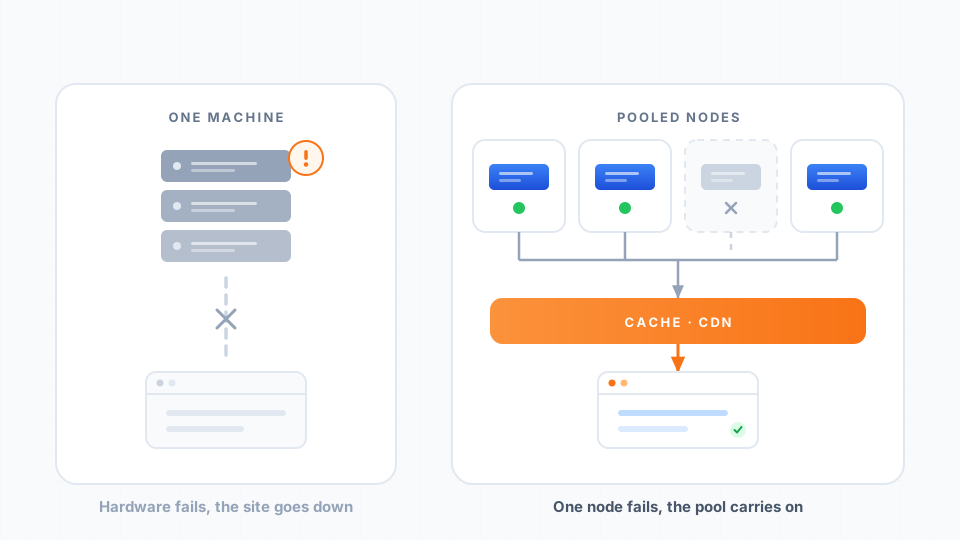
Traditional hosting puts your website on one machine. That machine has a fixed amount of CPU, memory and disk, and your site's ceiling is whatever is left after everything else on it has taken a share. If the machine fails, your site is down until someone fixes it or moves you.
Cloud hosting draws your site's resources from a pool of machines instead of one. A virtualisation layer sits between your website and the hardware, so the physical server your site runs on stops being a fixed fact. If one node in the pool develops a fault, another can take over the work. If your site needs more memory, it can be allocated from the pool rather than requiring someone to physically rebuild you somewhere new.
That produces exactly two real advantages: resilience, because no single machine failure has to take you offline, and elasticity, because capacity can change without a migration.
Everything else you will see advertised alongside the word — SSD or NVMe storage, server-level caching, a CDN, free SSL, a control panel you can actually use — is genuinely valuable and has nothing to do with the cloud part. Those features exist on ordinary single-server hosting too. Keep the two ideas apart when you compare quotes, because a well-specified single-server plan on fast local hardware will often serve pages quicker than a cloud plan on slower hardware further away. Resilience and speed are different purchases.
The Three Things Hosts Call "Cloud"
1. Shared hosting on cloud infrastructure
This is the most common version in the Malaysian SME market, and the one most people land on when they search for cloud hosting. Your account lives on a managed platform alongside other accounts, you get cPanel, and you do not get root access. The cloud part is the infrastructure underneath — pooled, redundant, and someone else's problem to maintain.
It is the cheapest of the three by a wide margin, and for the large majority of business websites, brochure sites, WordPress installs and small stores, it is also the correct answer. You are buying resilience and managed convenience, not a server.
2. Cloud servers and cloud VPS
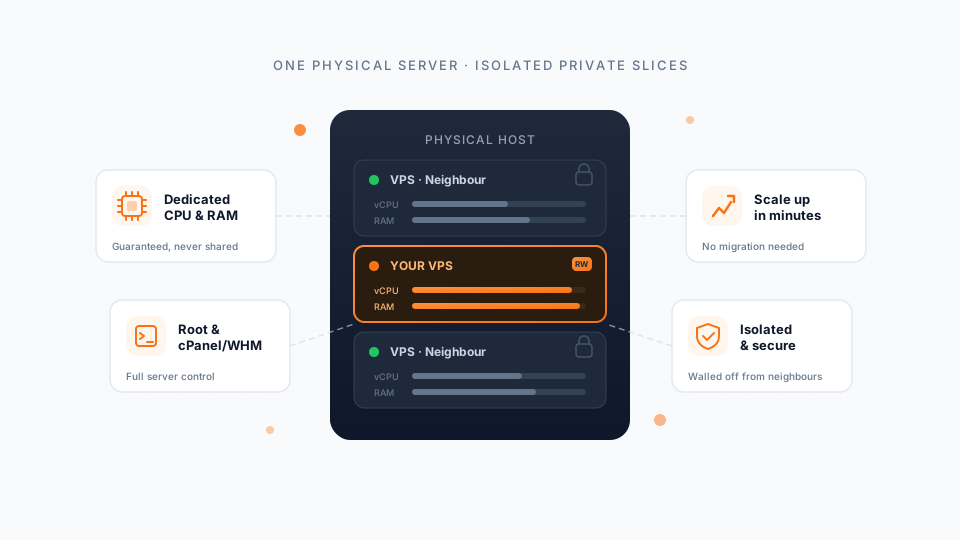
Here you get a virtual server of your own: root access, your choice of stack, dedicated CPU and RAM, and the ability to resize the instance when you need to. Billing is monthly, and on some platforms hourly. When someone searches for a cloud server in Malaysia, this is usually what they have in mind.
The catch is administration. A server of your own means you are responsible for it — security patches, service configuration, backups that actually restore — unless you pay for a managed version where the host handles that layer. If nobody on your team is comfortable in a Linux shell, buy managed or buy the first option. Our guide to VPS hosting and when to upgrade covers that decision in depth, because the managed-versus-unmanaged question matters more than the cloud label does.
3. Hyperscale platforms
AWS, Google Cloud and Azure sell raw building blocks: compute, storage, networking and a hundred services you assemble yourself. There is no hosting control panel, billing is metered and usually in US dollars, and the invoice scales with your architecture decisions — including your mistakes.
For an engineering team running a real application with real scaling requirements, this is the right tool. For a ten-page company website with a contact form, it is a considerable amount of complexity and a variable bill in exchange for capabilities the site will never use.
| If you are… | The version you want | Typical control panel |
|---|---|---|
| Running a business site, blog or small store | Cloud-based shared hosting | cPanel |
| Running a custom application or a busy store, with technical help available | Cloud VPS (managed unless you have Linux skills) | cPanel/WHM or your own stack |
| Running a product with an engineering team and variable scale | Hyperscale platform | None — you build it |
Cloud vs Shared vs VPS: The Honest Comparison
Most comparison tables you will find online quietly flatter the cloud column. Here is a more useful version, written around what actually differs day to day:
| Shared hosting | Cloud (shared) hosting | VPS | |
|---|---|---|---|
| Where resources come from | One machine, split between accounts | A pool of machines, split between accounts | A reserved slice of one machine |
| What you control | Your cPanel account | Your cPanel account | The whole server, with root |
| If hardware fails | You wait for a fix or a move | Another node picks up the work | You wait for a fix or a move |
| Growing | Upgrade plan, sometimes a migration | Move up a tier from the same pool | Add CPU, RAM and disk in place |
| Noisy neighbours | Possible | Possible | No — your slice is reserved |
| Typical Malaysian cost | RM180 – RM550 / year | RM250 – RM600 / year | RM200 – RM550 / month |
| Best for | Small, steady sites | Sites that need resilience and room to move | Custom stacks, heavy or transactional sites |
What Cloud Hosting Costs in Malaysia
Prices vary with specification, but the bands are fairly consistent across Malaysian providers:
| Product | Typical price | Billed |
|---|---|---|
| Cloud-based shared hosting | RM250 – RM600 / year | Usually annually |
| Managed cloud VPS | RM200 – RM550 / month | Monthly |
| Unmanaged cloud VPS | RM40 – RM250 / month | Monthly or hourly |
| Hyperscale platform | Metered, usually USD | Per-second or per-hour usage |
- The billing term. Many cloud shared plans are sold annually only. That is not a trap, but it does mean the entry price is a year's commitment rather than a month's trial. Check the refund window instead — a 30-day money-back guarantee is a reasonable expectation.
- The renewal price. A discounted first term that renews at double is common across the whole hosting industry. Multiply by the number of years you intend to run the site, not by one.
- Backup retention. "Daily backups" means little without a retention period. Fourteen days is standard, thirty is generous, and the number matters most on the day you discover a problem that started three weeks ago.
- Whether scaling is self-service. Elasticity you have to open a support ticket for is not elasticity. Ask whether you can move up a tier yourself, and whether it needs a migration.
The Question That Matters More Than the Word "Cloud"
Where is the infrastructure physically located?
Cloud does not mean "everywhere". Every cloud plan runs in one or more specific regions, and plenty of cloud hosting sold in Malaysia runs from the United States or Europe, because capacity there is cheaper. That is a legitimate trade — it is how a resilient cloud plan can cost RM280 a year — but it is a trade you should make knowingly.
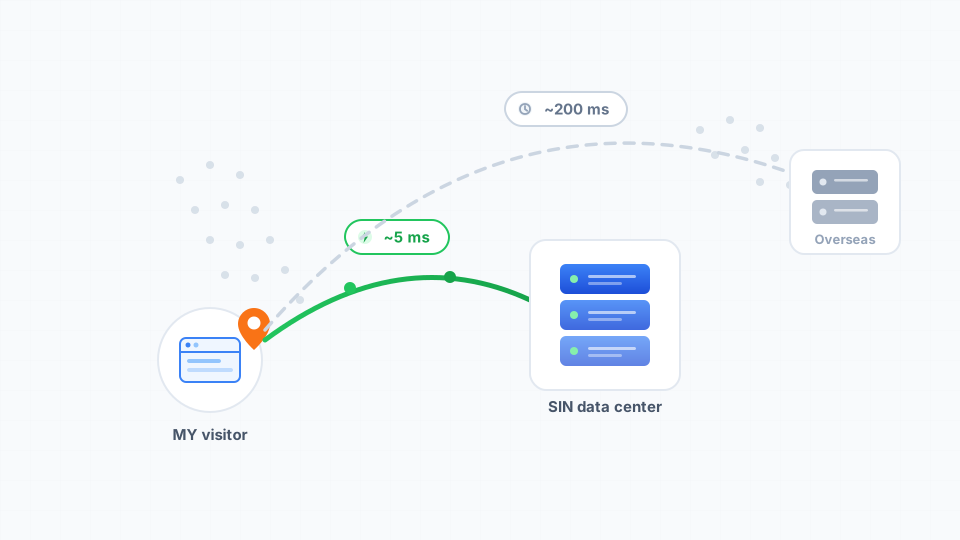
Distance costs you a fixed amount of time on every request, before your server does any work at all. A caching layer and a CDN shield you from most of that for static content: images, stylesheets, cached pages. What they cannot cache is anything personal or transactional. A logged-in dashboard, a cart, a checkout, a form submission — those go all the way to the origin server and back, every time. For a content site, faraway infrastructure with good caching in front of it is genuinely fine. For an online store taking payments from Malaysian shoppers, in-region hosting is not a luxury.
We apply that split to our own plans, and it is worth saying plainly: Cynet's cloud hosting runs on US cloud infrastructure, chosen for cost efficiency, with Nginx Turbo Cache and Cloudflare's CDN in front of it so cached content is served from nodes near your visitors. Our Business, WordPress and Premium plans run from our Singapore data centre instead — milliseconds from Malaysian visitors, which is what a latency-sensitive site needs. Neither is the better product in the abstract. They are answers to different questions.
If you want to understand how much distance actually costs and how to measure it yourself before buying anything, our guide to server location and hosting speed in Malaysia walks through the testing.
When Cloud Hosting Is the Right Choice
Cloud hosting is a good fit when:
- Your traffic is spiky rather than steady. Campaign launches, 11.11 and year-end sales, a post that gets shared — pooled resources absorb surges better than a fixed slice of one machine.
- You run several small sites. One plan covering ten or twenty sites is usually cheaper and simpler than separate hosting for each.
- You want to roll back your own mistakes. Snapshots taken before a theme change or a plugin update turn a bad afternoon into a five-minute fix.
- Staying online matters more than winning a speed test. Redundancy is what you are buying. If your site has to be reachable, this is the right trade.
- You expect to grow but not to re-platform. Moving up a tier within the same pool is a far smaller event than migrating to a new server.
- Your visitors are Malaysian and your site is transactional. Pick in-region hosting and accept that it may not be branded as cloud.
- You need root access or a custom stack. That is a VPS, managed if you would rather not run it yourself.
- Your site is small, quiet and likely to stay that way. A standard shared or website builder plan costs less and will not feel slower.
- You expected to pay by the hour. Hourly billing belongs to cloud VPS instances and hyperscale platforms, not to managed cloud shared hosting.
How to Evaluate a Cloud Hosting Provider
The word tells you nothing, so ask questions that do. Seven, in rough order of how much they matter:
- Which region will my account be in? If the answer is vague, treat it as "far away". Test the latency yourself before you buy.
- Is this shared, or a server of my own? In other words: do I get root? This single question sorts the three products described above.
- How do I add resources, and does it need a migration? Self-service tier changes are the feature you are paying for.
- What exactly is backed up, how often, kept how long, and can I restore it myself? Backups you cannot trigger and restore without a support ticket are an insurance policy with a phone tree.
- What is the uptime commitment, and what happens if it is missed? An SLA with no remedy is a sentence, not a guarantee.
- Is billing in ringgit, and what is the renewal price? MYR billing removes exchange-rate surprises; the renewal figure is the price you will actually live with.
- Who answers on a Saturday night? A checkout failure during Malaysian shopping hours needs a reply during Malaysian shopping hours.
Getting Started
If the cloud-based shared option is the one that fits, the specification to look for is unglamorous: SSD storage, a server-level cache, snapshots you control, daily backups with a retention period you have actually read, cPanel, and support in your time zone.
Cynet's cloud hosting plans start at RM280 a year for a single site with 10GB of SSD storage, unlimited email accounts, free SSL and Nginx Turbo Cache, and step up to twenty sites with 40GB and double the CPU and RAM allocation. Daily backups are kept for thirty days, you can take your own snapshots before risky changes, and every plan carries a 30-day money-back guarantee. There is no root access, because it is managed shared hosting on cloud infrastructure — which, for most business websites, is the point.
If your priority is local latency rather than pooled redundancy, business hosting from our Singapore data centre is the better starting point, and our comparison of every plan type lays the options out side by side.
The Bottom Line
- "Cloud hosting" describes infrastructure, not a product. Three very different things are sold under the name, from RM280 a year to a metered USD invoice.
- The architecture buys you exactly two things: resilience against hardware failure, and the ability to change capacity without migrating. Speed, storage and caching are separate purchases.
- Cloud-based shared hosting is still shared. It protects you from a failing machine, not from a busy neighbour — that is what a VPS is for.
- Region beats branding. A cloud plan hosted far away with a CDN in front of it is fine for content and wrong for checkouts.
- Ask the seven questions above. A provider who answers all of them plainly is telling you more than any amount of cloud vocabulary.